
Understanding Anger: A Path to Personal Growth
Anger is often misunderstood, seen as a negative emotion. This article explores how understanding and channeling anger can lead to personal growth and healthier relationships.

Anger is often misunderstood and undervalued in our emotional landscape. Many perceive it as a negative force, something to hide or eliminate. However, what if we learned to listen to our anger and use it as a tool for personal development?
In this article, we will explore how anger, when understood and channeled appropriately, can become a significant emotional ally.
What is Anger and Why Do We Feel It?
Anger is a primary emotion, akin to sadness or joy. It typically arises when we perceive injustice, feel our boundaries are crossed, or have unmet needs.
Daniel Goleman, author of Emotional Intelligence, explains that all emotions serve an adaptive function. In the case of anger, its role is to mobilize us to protect ourselves or to address something that is wrong. It is not irrational; rather, it provides us with essential information.
When we fail to identify and regulate our anger, it can manifest as outbursts, arguments, violence, or impulsive decisions.
Marsha Linehan, the creator of Dialectical Behavior Therapy (DBT), emphasizes that while anger is a legitimate emotion, it requires emotional regulation skills to prevent it from controlling us. The goal is not to suppress it but to validate and manage it wisely.
Anger can drive change, prompting us to act, express our thoughts, and defend what we value. Ellen J. Langer, author of Mindfulness, suggests that emotions can be better managed when we adopt a mindful, attentive, and non-judgmental mindset.
By practicing mindfulness, we can become aware of when anger arises, what triggers it, and how to choose a more conscious response instead of an automatic reaction.
What to Do When Anger Arises
Here are five straightforward and effective recommendations for managing anger:
- Pause and Breathe: Taking a moment allows your mind to choose a response consciously rather than react impulsively.
- Name It: Acknowledge your feelings by saying, “I am angry because I felt unappreciated.” Labeling the emotion can reduce its intensity.
- Validate Your Emotion: Remember, it’s okay to feel this way. What matters is how you express it. “This is important to me; it hurt to want to share and feel ignored, which is why I got angry.”
- Identify the Underlying Need: Consider whether you need respect, space, or acknowledgment.
- Express It Assertively: Use “I feel that…” statements and avoid blaming or shouting.
What Happens If We Ignore Anger?
Ignoring or repressing anger does not make it disappear; instead, it accumulates. This buildup can lead to anxiety, insomnia, chronic fatigue, sadness, or even physical illnesses. As Goleman notes, “Unexpressed emotions don’t die; they just hide and later resurface in more destructive ways.”
In many therapy sessions, beneath anger lies vulnerability, such as sadness, disappointment, or fear. When we listen to our anger without judgment, it becomes a guide, indicating what is important to us, what we are unwilling to tolerate, and what we wish to change.
Linehan points out that validating emotions does not equate to justifying destructive behaviors. You can feel angry without acting impulsively.
Mihály Csíkszentmihályi, a psychologist known for his theory of flow, suggests that when a person is engaged with their emotions and actions, they can achieve a profound emotional balance. Applied to anger, this means that by learning to be present without rejecting or exaggerating the emotion, we can act with greater clarity.
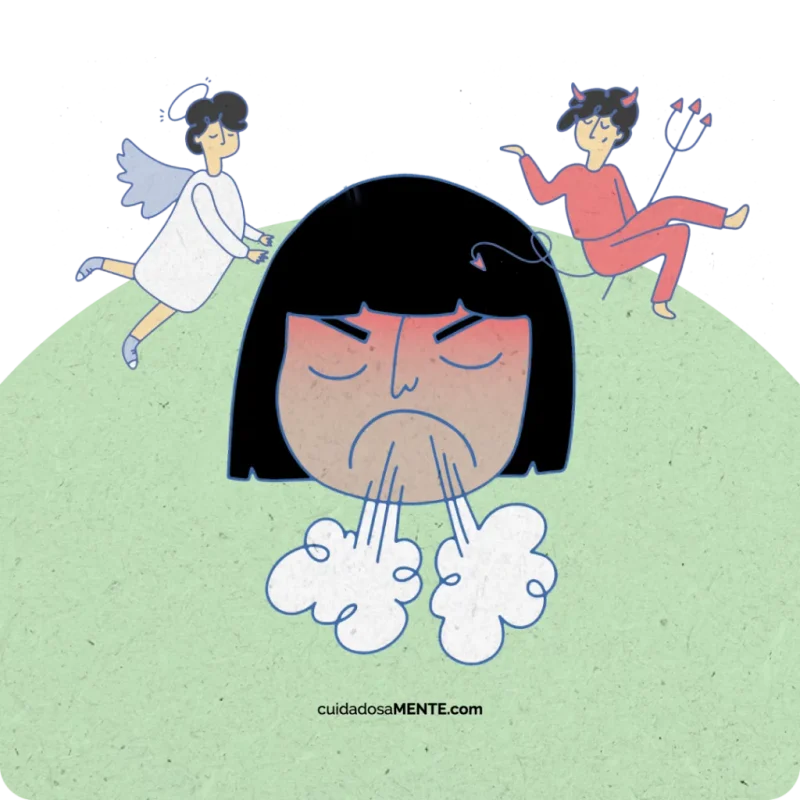
Anger transforms from chaos into directed energy for well-being.
What Does Healthy Anger Look Like?
- Communicating clearly without causing harm.
- Setting boundaries without guilt.
- Defending what is important to you.
- Making necessary changes in your relationships or environment.
- Acknowledging your emotions without shame.
What If I Get Angry Too Often?
Feeling angry does not make you a “bad” person. It simply indicates that your emotional system is trying to communicate something.
If anger is frequent, intense, or leads to conflict, discussing it in therapy could be highly beneficial. A professional can help you identify emotional patterns and provide practical tools to enhance your daily well-being.
How to Support Someone Who Gets Angry Easily?
- Avoid labeling them as overreacting.
- Validate their feelings, even if you don’t share their reaction.
- Help them articulate what they feel.
- Encourage them to seek tools for better expression.
- Prioritize your emotional safety if the situation becomes harmful.
Remember, anger is not an enemy to be avoided, denied, or eliminated; it is an ally that requires training. The key is not whether you feel anger but how you manage it. You can learn to express yourself assertively without causing harm, foster more authentic relationships, establish healthier boundaries, and live with greater coherence.
Therapeutic settings provide an ideal environment to transform anger into growth. Instead of asking, “Is it wrong to be angry?” consider asking, “What is this anger trying to tell me about myself and what I need to change?”
Would you like to work through this and other emotions to live a fuller life? Schedule your online therapy session with CuidadosaMENTE.

Psic. Alejandro Morelos
Clinical Psychologist at CuidadosaMENTE
References:
- Goleman, D. (1995). Emotional Intelligence. Editorial Kairó
- Linehan, M. (1993). Cognitive-Behavioral Treatment of Borderline Personality Disorder. Guilford Press.
- Langer, E. J. (1989). Mindfulness. Addison-Wesley.
- Csíkszentmihályi, M. (1990). Flow: The Psychology of Optimal Experience. Harper & Row.