
The Daily Challenge: Can You Find the Right Answer to This Calculation in Under 30 Seconds?
You have 30 seconds to solve this calculation that seems harmless. The trap? A parenthesis and a multiplication are enough to make even the fastest doubt. So, instinct or method?

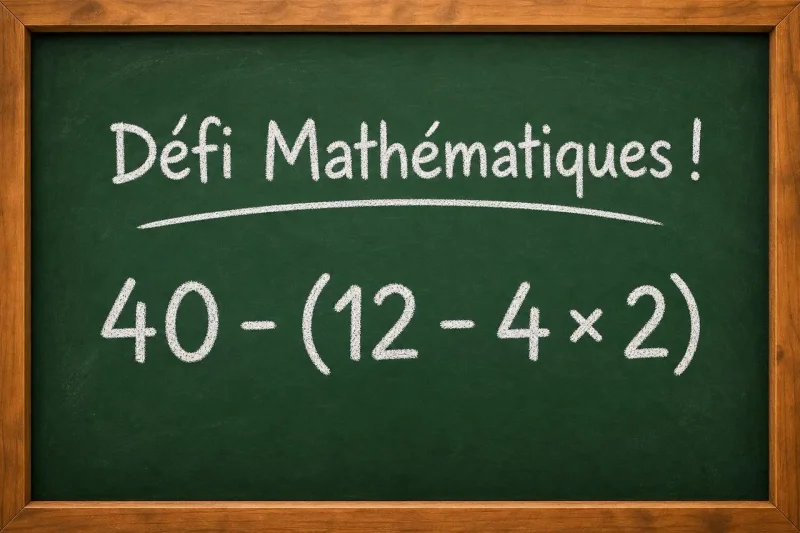
The Daily Challenge
You have 30 seconds to solve this seemingly harmless calculation. The trap? A parenthesis and a multiplication are enough to make even the fastest doubt themselves. So, is it instinct or method?
At Psychologies, we have always explored the mechanisms that shape our choices, capture our attention, and influence our reasoning. These little mental challenges not only test our calculation abilities: they also reveal how our brain relies on automatic reflexes, sometimes at the expense of accuracy. Today's calculation is a striking demonstration of this. At first glance, it seems so simple that it seems impossible to get it wrong. Yet, it is precisely this impression of ease that leads the majority of participants to a wrong answer. Will you be able to outsmart the trap? You have 30 seconds to find the right solution.
What This Challenge Really Tests
Before you dive in, here’s what this challenge really tests:
- Your logic when faced with a short but tricky expression
- Your concentration under slight time pressure
- Your mental speed without rushing
- Your adherence to the order of operations
The calculation to solve is as follows:
Your mission is simple: find the correct answer in under 30 seconds. But don’t let the apparent simplicity lull you into complacency. The trap lies in the parenthesis, specifically in how it is treated. If you feel your brain wants to respond immediately, that’s normal. It’s even the purpose of the challenge. Take a short pause, look at the structure, and only then validate your intuition. On mobile, this type of calculation is even more misleading: we read quickly, scroll quickly, respond quickly… and make mistakes quickly.
A good way to play is to announce your answer mentally, then reread the expression a second time. If your answer remains the same, you can be confident. If you hesitate, it means the trap has started to take effect. In the same spirit, this other primary-level calculation challenge clearly shows why the simplest operations are not always the most successfully completed. The displayed level doesn’t say it all: attention is just as important as technique. So, do you have an answer? Keep it in mind before moving on. The solution part is coming now, and that’s where we see if you avoided the classic trap.
Why This Little Challenge Captivates Our Brain
This type of calculation works because it puts us in a very familiar situation: something seems obvious, so our brain wants to save energy. It looks for a shortcut. It whispers an answer to you, very quickly, with a lot of confidence. The problem is that confidence is not always a sign of correctness. Parentheses have this strange power: they give the impression of simplifying the calculation, while they actually impose a strict rule. Add a multiplication inside, and you get the kind of detail that the eye spots… or completely ignores.
If you like this format, you may have already encountered a calculation to solve in under 30 seconds. Same principle: the statement seems light, but it mainly tests your mental discipline. It’s not a matter of academic level; it’s a matter of attention at the right moment. The phrase is well-known, and it fits this challenge perfectly. Here, there’s no need for long reasoning. You just need to maintain control over the order of operations. A parenthesis, a multiplication, a subtraction: three simple elements, but only one proper way to chain them together.
The Solution: Avoiding the Parenthesis Trap
If your first answer came too quickly, don’t panic. This challenge is precisely designed to provoke that reflex. The correct approach is not to treat the parenthesis as a simple left-to-right reading, but to respect the order of operations inside.
- Step 1: First, identify the parenthesis. It indicates that this part of the calculation must be treated with care before completing the entire expression.
- Step 2: Inside the parenthesis, multiplication must be considered before subtraction. That’s the detail that many rushed readers forget.
- Step 3: Once the correct order is respected, return to the main calculation. By following this logic without changing methods along the way, you arrive at the provided answer.
The final answer is therefore clearly: 36.
If you found this result in under 30 seconds, congratulations: you combined speed and control. If you fell into the trap, it’s even more interesting. It shows how our brain sometimes prefers to go fast rather than check. And that’s exactly why these challenges make you want to try again.