
Understanding Social Anxiety vs. Shyness
Public speaking, meeting new people, and initiating conversations can be uncomfortable for many. Understanding the difference between shyness and social anxiety is crucial for personal growth.

Public speaking, meeting new people, initiating conversations, or simply making a phone call can be daunting experiences for many individuals.
Feeling nervous in certain social situations is a common occurrence, but when this discomfort becomes persistent and overwhelming, it may indicate something beyond mere shyness.
This article delves into the nature of social anxiety, how it differs from shyness, the factors that contribute to its persistence, and practical tools to cope with it. Additionally, a practical exercise will be included to help identify thoughts and beliefs that arise in social situations, a crucial step in addressing these feelings.
What Causes Discomfort in Social Situations?
It is typical for most people to feel uneasy in various social contexts, and this does not necessarily signify a problem.
This discomfort can stem from numerous factors, including past experiences, insecurity, personal beliefs about ourselves and others, or fear of negative judgment. Often, a previous experience where one felt embarrassed, humiliated, exposed, rejected, or ridiculed can generalize that feeling, causing a person to experience it again in new situations.
People may learn to perceive being observed or interacting with others as dangerous or threatening.
To cope with these feelings, some individuals develop strategies such as remaining silent for fear of making a “mistake” or constantly monitoring themselves, making assumptions about how others perceive them.
For some, there may even be a self-imposed demand to behave “perfectly” in public, which can heighten pressure and, consequently, anxiety.
How Do Shyness and Social Anxiety Differ?
These terms are often used interchangeably, as both relate to the fear of facing social situations. However, shyness is typically characterized by a less generalized fear, allowing for easier interaction in those contexts.
In contrast, social anxiety involves a more intense level of discomfort, often manifesting as anticipatory fear before the social event, which increases the likelihood of avoiding interaction altogether. This avoidance can significantly impact various aspects of life.
Interestingly, shyness can sometimes predispose individuals to develop social anxiety due to irrational beliefs and certain avoidance coping mechanisms that may intensify over time.
In summary, the primary differences lie in the intensity of feelings, avoidance behaviors, and overall quality of life.
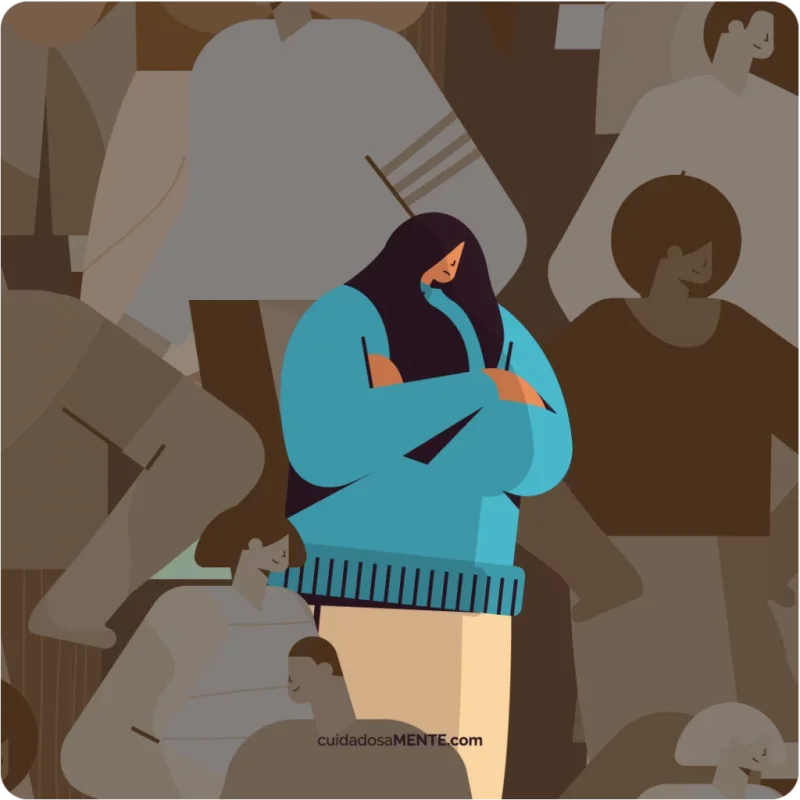
When Should One Address Social Anxiety?
Anxiety serves an adaptive purpose, preparing us to respond to uncertain or threatening situations. Its main function is to anticipate potential dangers and equip us to act accordingly.
However, it can escalate into an anxiety disorder, commonly referred to as social phobia, when fear and worry negatively impact various life contexts.
Social phobia is characterized by excessive and irrational fear of social interactions, leading to cognitive, physiological, and behavioral responses:
• Cognitive
Irrational or catastrophic thoughts regarding the fear of being observed, negative evaluation by others, or the prospect of experiencing embarrassment or rejection in situations that feel out of control.
• Physiological
A state of heightened alertness accompanied by symptoms such as trembling, sweating, rapid heartbeat, agitation, difficulty breathing, muscle tension, dry mouth, gastrointestinal discomfort, tingling, or numbness, which can lead to intense discomfort or even anxiety attacks.
• Behavioral
Avoidance or escape from situations that induce discomfort. Some may physically be present but lack genuine engagement or mindfulness.
It is essential to recognize that everyone experiences these issues differently, so not all symptoms may manifest. For some, intrusive thoughts may be more challenging to manage than physiological activation.
As a result, individuals may feel distress days or weeks before an event, triggering cognitive and/or physical responses.
If left unaddressed, anxiety can become a self-reinforcing cycle. Avoiding triggers provides temporary relief but strengthens the belief that one cannot cope with the situation.
Moreover, physical sensations of discomfort can further validate intrusive thoughts like “I’m going to have a panic attack” or “they will laugh at me.” Consequently, social phobia persists due to how one responds to anxiety in the present.
This can also negatively impact self-esteem, foster feelings of insecurity, and, in some cases, coexist with depressive disorders.
Is It Possible to Feel More Confident in Social Situations?
Yes, when anxiety significantly affects quality of life and symptoms hinder approaching the desired lifestyle, seeking professional help is crucial.
Learning to manage anxiety enables individuals to make decisions aligned with their values rather than allowing fear or discomfort to dictate their actions.
There are tools available to assist in this process. Below is an exercise designed to help identify whether thoughts are fueling social anxiety, paving the way for addressing them. There are no right or wrong answers.
Questionnaire: Are My Thoughts Fueling My Social Anxiety?
- How do I view myself in social situations? I see myself as nervous, feeling like I don’t know what to say. I think my voice shakes and that I appear insecure.
- How do I believe others see me? I assume they notice that I’m uncomfortable, that I lack confidence, and that I have nothing interesting to contribute.
- What do I think others expect from me? I think they expect me to be articulate, confident, and to speak without hesitation, having brilliant ideas.
- How likely do I feel to meet those expectations? I feel it’s very difficult. I think there’s always someone who does it better and that I’m not at that level.
- What consequences do I imagine if I don’t meet those expectations? I believe they will think I’m not fit for this job, that I’m worthless, or that I shouldn’t have been invited.
- How realistic is it that those consequences will actually occur? If I think it through, they probably aren’t very realistic. No one has said that to me directly. Sometimes others are also nervous, and I have participated before without anything serious happening.
- How would I like to be in these situations? I would like to feel calmer, participate without so much fear, speak more clearly, and trust what I have to offer.
- Is there something I can do to get closer to that? Yes, I could prepare in advance, practice what I want to say, and work on challenging these negative thoughts. Maybe I could start by speaking once, even if it’s little, and gradually gain confidence.
Conclusion...
In addition to questioning thoughts, one can also work on social skills training and gradual exposure to situations that induce discomfort, aiming to reduce fear and enhance coping abilities so that these experiences become less limiting.
While this is not an easy path, with professional psychological support and a compassionate approach, it is possible to make progress and learn to manage social anxiety effectively.

Psic. Lucía Guerrero
Psicóloga clínica en CuidadosaMENTE